Entrance Automation
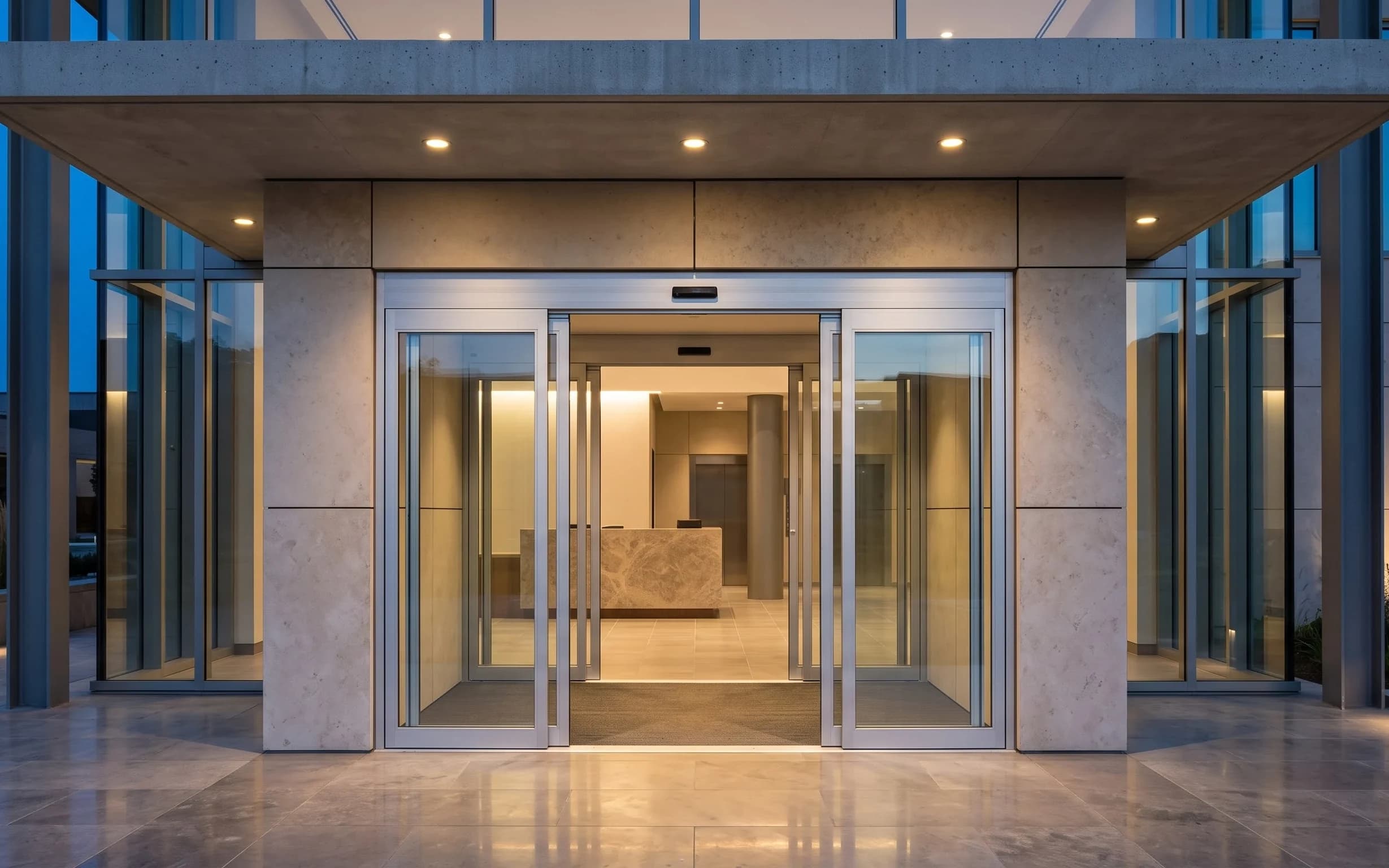
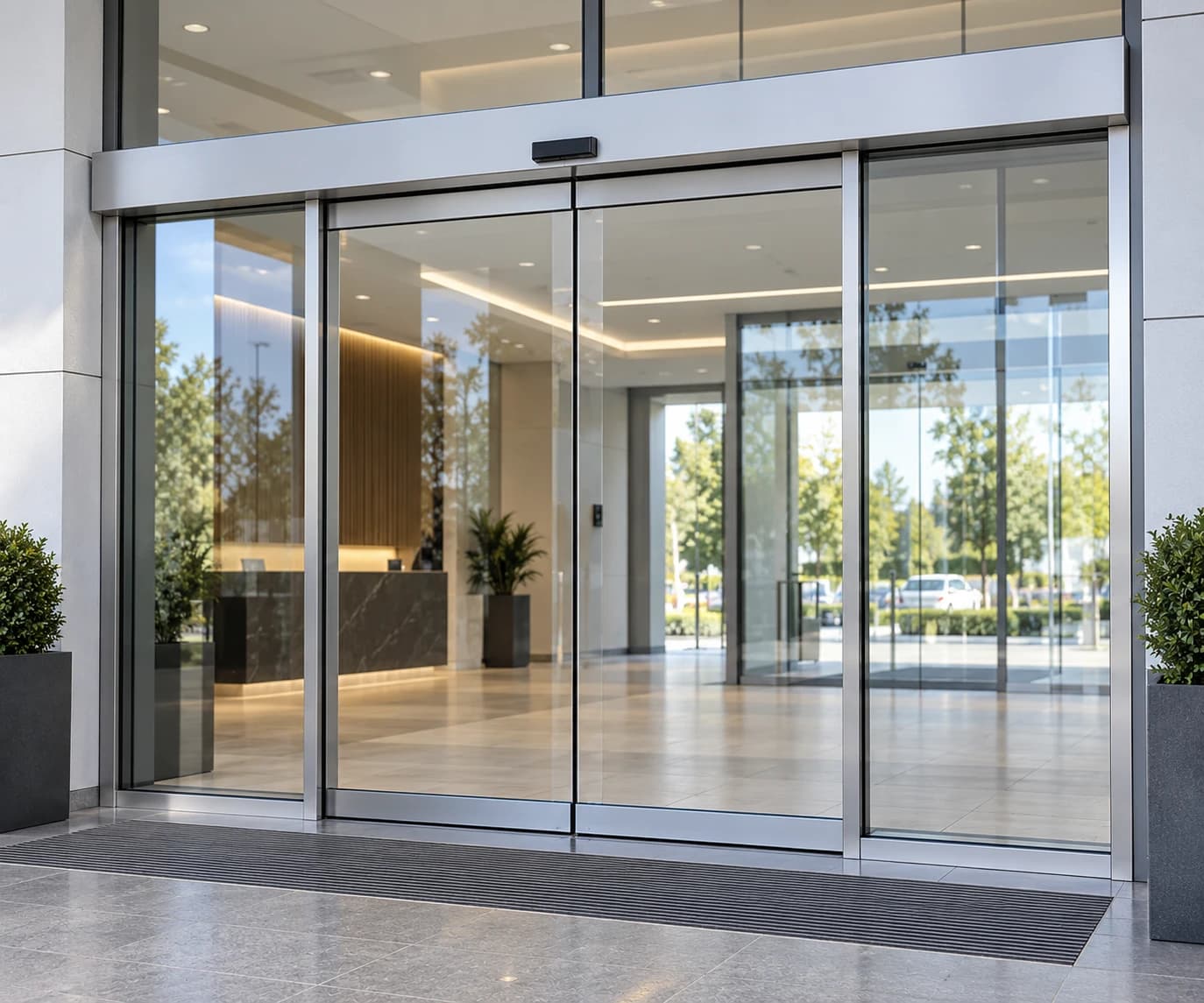
Automatic Sliding Glass Doors
Sensor-operated sliding glass door systems for lobbies, retail and healthcare entrances, in single-leaf and bi-parting arrangements with defined egress behaviour.
4 configurations
Explore product
Entrance Automation/Automatic Swing Doors
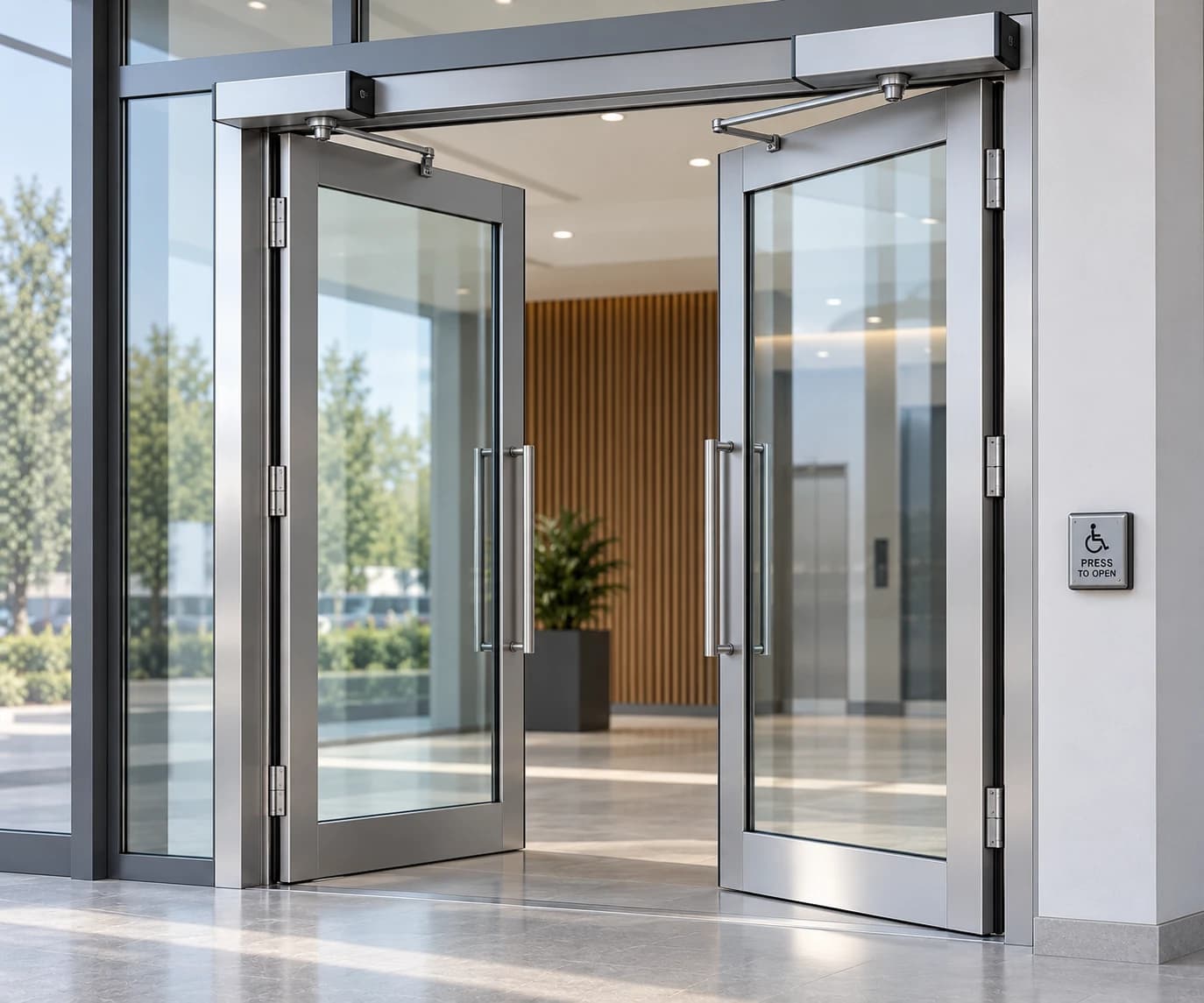
Powered hinged leaves where a sliding track will not fit.
 Entrance Automation
Key specifications
* Final specification depends on door dimensions, configuration, operating environment and project requirements.
01Overview
An automatic swing door puts a powered operator on a conventional hinged leaf. It suits openings where there is no room beside the door for a sliding leaf to run, where the door must remain usable as an ordinary swing door, and where an existing doorset is being upgraded rather than replaced.
03Variants
The same product, built for a different job. Where a specification depends on opening dimensions, selected profile, operating duty or site conditions, the final configuration is confirmed during technical assessment.
Opens slowly enough that kinetic energy is limited by design. The usual choice for accessible entrances and public corridors.
Faster operation for higher traffic, requiring presence sensing and guarding around the swing arc.
Two operators sequenced so the leaves open and close in the correct order at a meeting stile.
Operator housed within the transom where the entrance is architecturally sensitive.
10Gallery
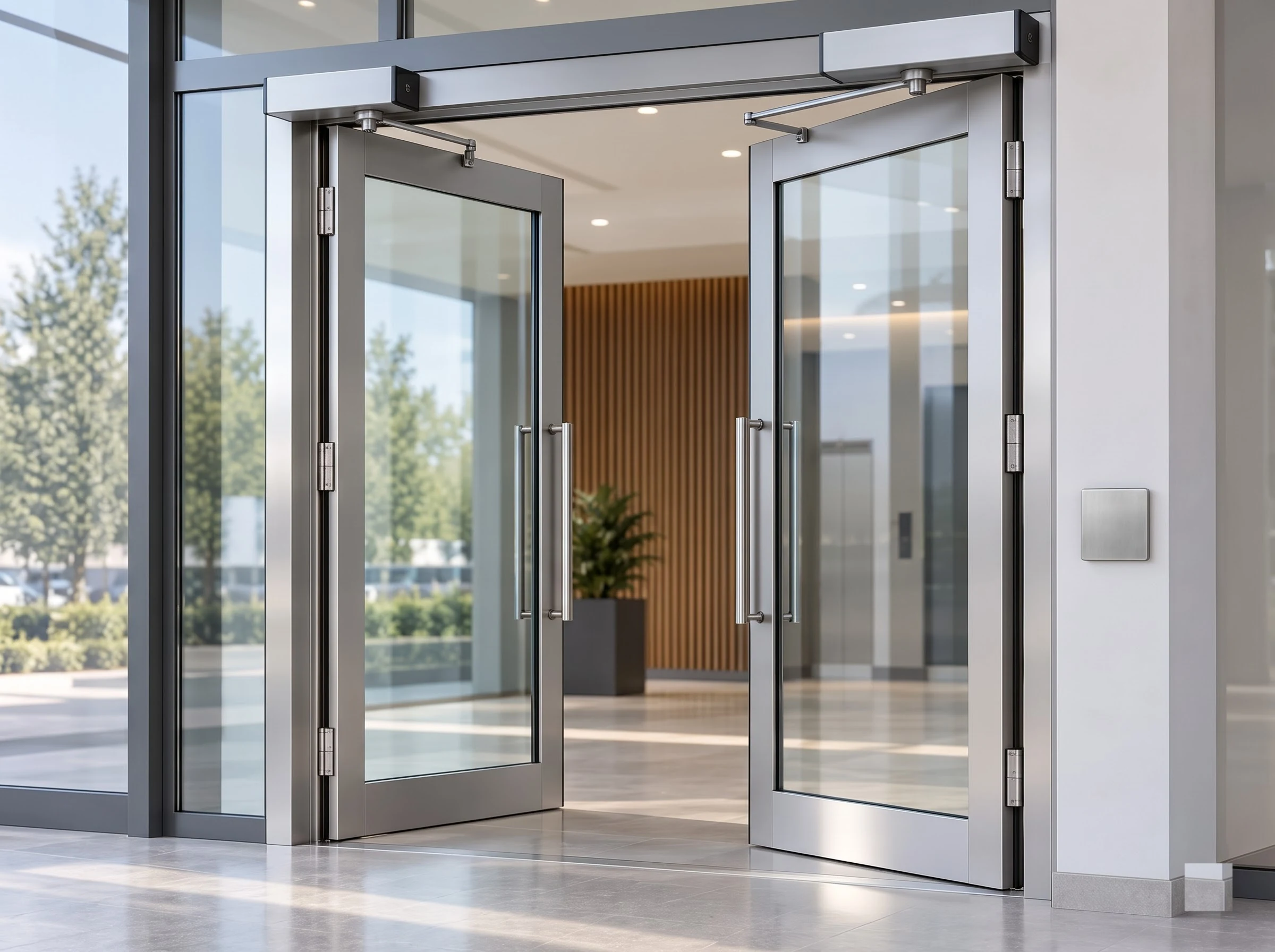
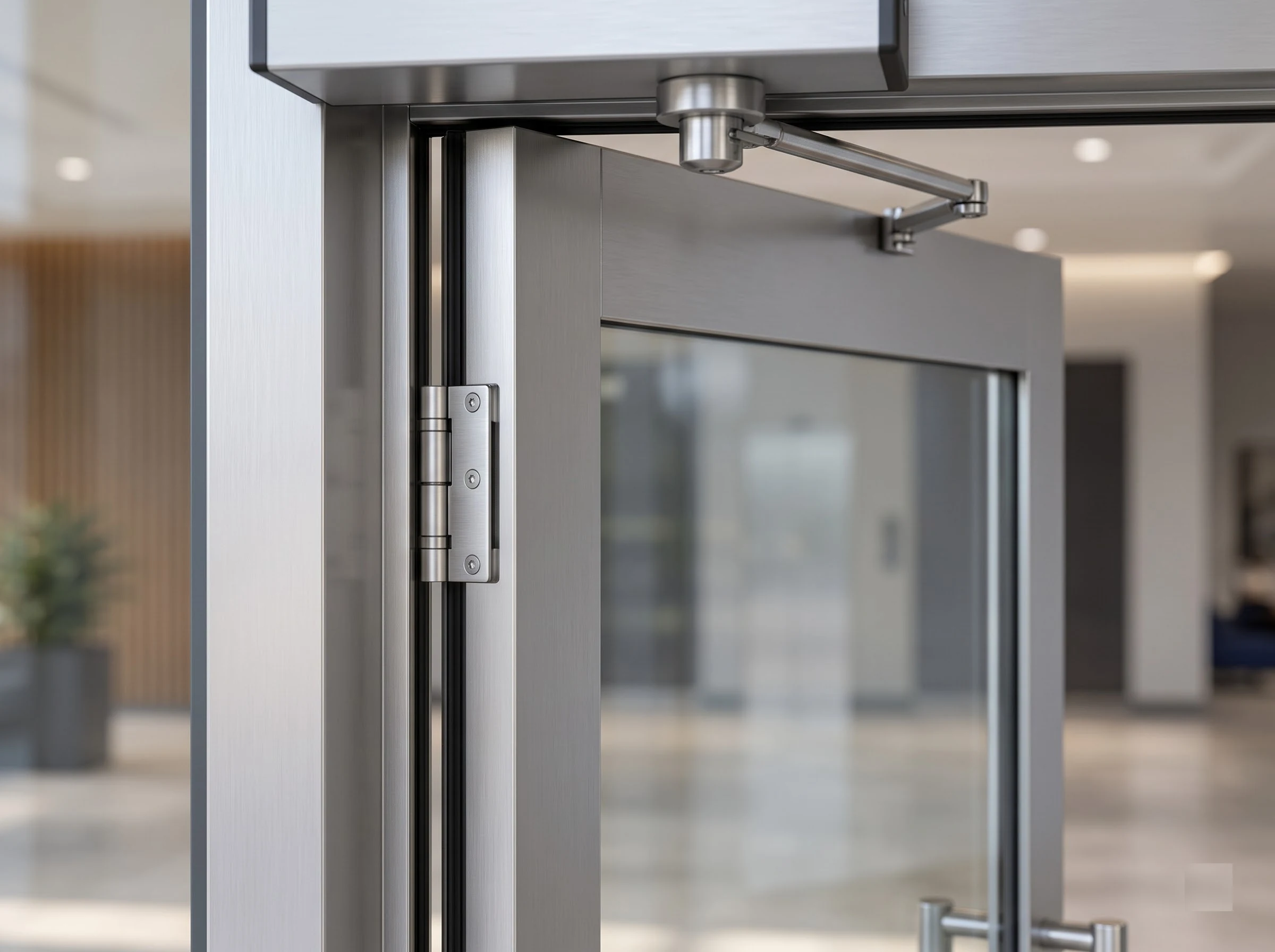
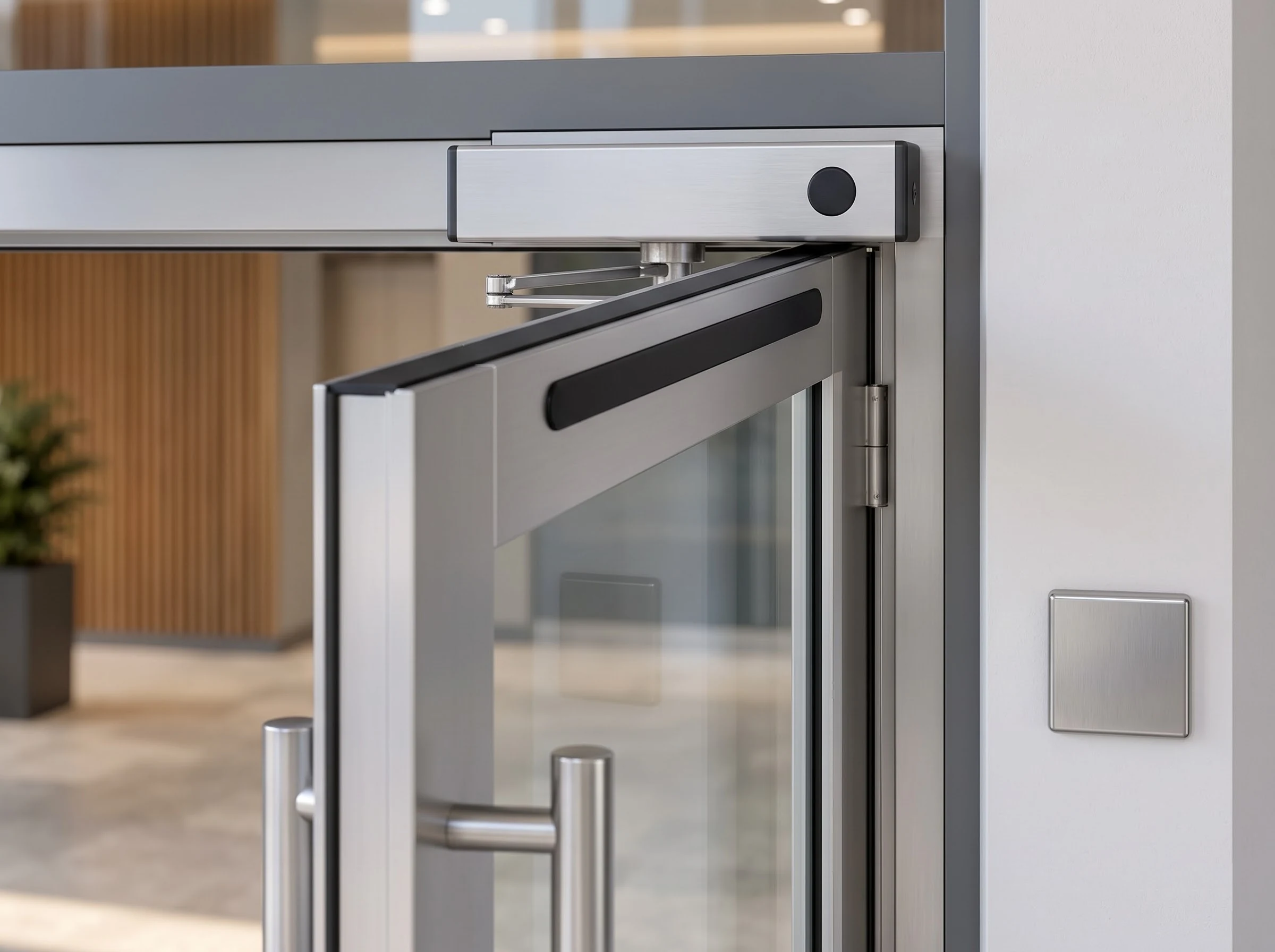
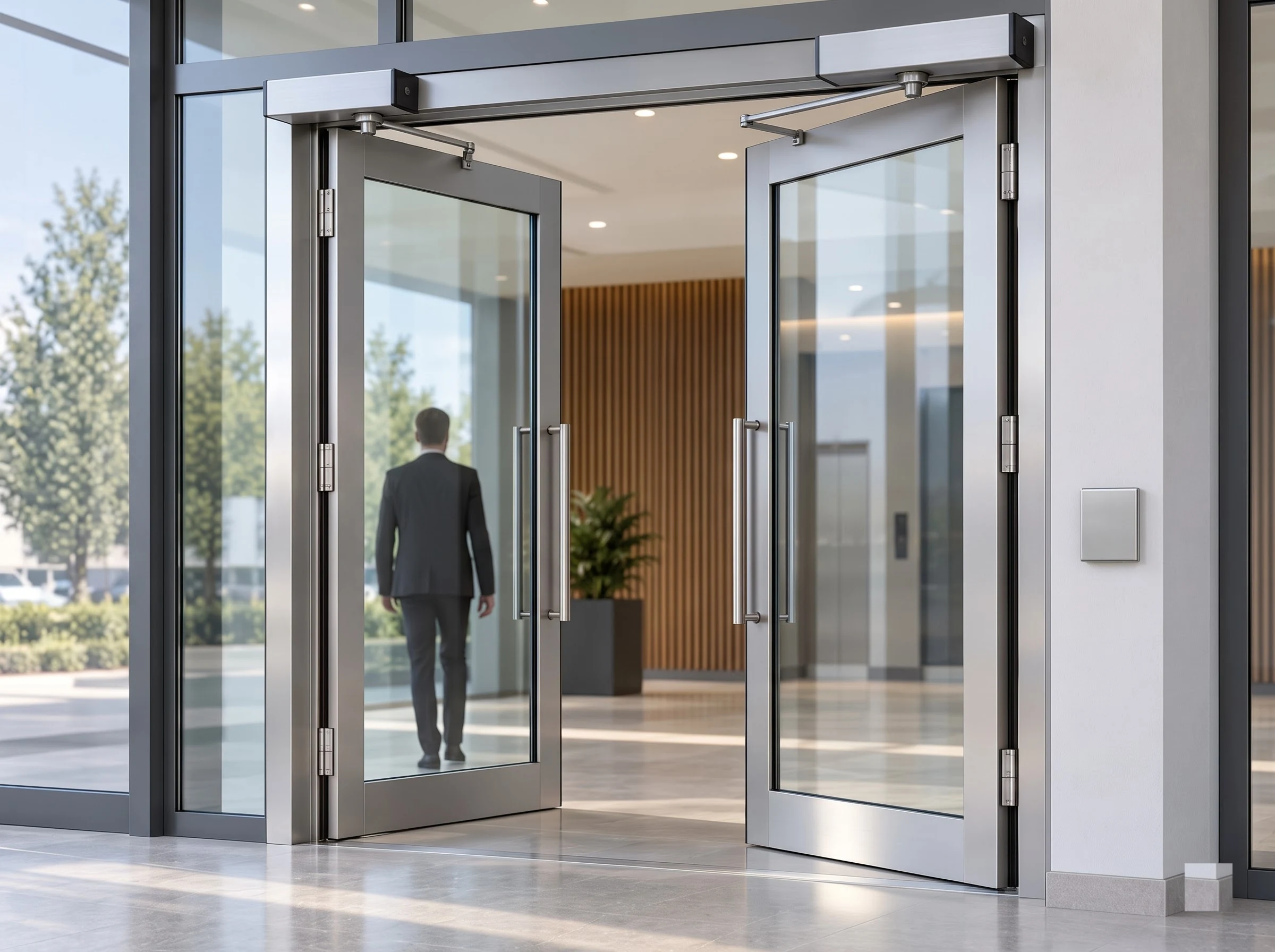
04Technical specifications
Technical data is shown first; features, applications, compatibility, installation, safety, ordering and downloads are a click away.
Clear opening between finished reveals.
Space above the opening for the barrel, stack or track.
Per side, for guides and drive.
Single, bi-parting or telescopic.
EN 16005.
EN 16005 applies to power-operated pedestrian doorsets.
| Maximum clear widthClear opening between finished reveals. | Leaf widths typically 700–1,100 mm on standard operators and up to 1,600 mm on heavy-duty operators; double-leaf sets from about 1,400 mm between hinges |
|---|---|
| Maximum clear height | Set by the leaf construction; confirmed per project |
| Minimum headroom requiredSpace above the opening for the barrel, stack or track. | The operator body, typically 70 mm high, fitted to the door head or the transom |
| Minimum side room requiredPer side, for guides and drive. | None beyond the leaf swing; the operator sits above the leaf |
| Header depth and height | Operator typically around 685 × 70 × 130 mm; reveal depths to 300 mm with a standard arm, up to 500 mm on heavy-duty operators |
| Maximum leaf weight | Typically up to 160 kg on standard operators and up to 400 kg on heavy-duty operators, reducing with leaf width and reveal depth |
| Opening speed | 0–90° in about 3–12 s, adjustable; limited automatically in low-energy mode |
|---|---|
| Closing speed | 90–0° in about 4–21 s, adjustable |
| Hold-open time | Adjustable, typically up to 30 s; 180 s on some operators |
| Rated daily cycles | Continuous duty; operators carry a cycle counter to 1,000,000 and are designed for heavily frequented doors |
| Leaf arrangementSingle, bi-parting or telescopic. | Single or double leaf, push or pull side, with an integrated door coordinator on double-leaf sets |
|---|---|
| Glazing | To the door leaf specification; the operator is independent of the leaf construction |
| Frame and track | Surface-mounted operator on the frame head with a standard arm on the push side or a slide channel on the pull side |
| Threshold detail | No threshold hardware; the existing door threshold is retained |
| Finish | Operator cover in silver anodised aluminium as standard, or powder coated to a RAL colour |
| Operator type | Electromechanical swing door operator with force-balancing gear and an integrated door closer function |
|---|---|
| Rated motor power | Low; operator consumption typically 120–240 W maximum depending on model |
| Supply voltage | 230 V AC single phase 50 Hz; 24 V DC supply for external accessories |
| Duty rating | Continuous automatic operation; temperature-managed overload protection on current operators |
| Manual override | Leaf opens by hand at all times; power-assist reduces the effort while the operator is powered |
| Mode selector | Integrated programme switch with off, automatic, permanent open and exit-only modes; key switch for night operation |
|---|---|
| Activation sensors | Radar motion detectors, push buttons, key switches, access control or push-and-go on the leaf itself |
| Presence sensors | Safety sensors on the hinge and opposite-hinge sides with self-test, required for full-energy operation |
| Part-open width | Not applicable; the opening angle is set on commissioning, up to about 110° |
| Interfaces | Potential-free door status contacts, motor lock feedback, emergency-off and lock inputs; fire alarm and building management through the same terminals |
| Behaviour on power failure | The leaf remains a manually operable door and closes under the operator's spring; no backup supply is needed for egress |
|---|---|
| Break-out leaves | Not applicable; a swing door leaf is already free to open by hand |
| Presence detection in the threshold | Safety sensors on both faces of the leaf stop or reverse it against a person in the swing path |
| Escape route complianceEN 16005. | Low-energy operation limits speed and force where sensors are not fitted; full-energy operation with safety sensors on higher-traffic doors; the supplied operator's declaration applies |
| Product standardEN 16005 applies to power-operated pedestrian doorsets. | Power-operated pedestrian doorsets fall under EN 16005; operators are type-tested by their manufacturers and the supplied operator's declaration applies |
|---|---|
| Conformity marking | As applicable to the supplied operator and market |
| Certificate reference | Operator manufacturer's type-test documentation for the supplied model; available on request |
Final specification depends on door dimensions, configuration, operating environment and project requirements.
FAQ
Engineering enquiry
Five answers about the opening are usually enough for us to come back with a configuration and a price.
Get in touch
If it is easier to describe the opening than to write it down, call or message us and we will work through it with you.