
Skip to content
Standard Automatic Solutions Pvt. Ltd.

High Speed Doors/Roll-Up High Speed Doors

High Speed Self-Repairing Door

A high speed door for heavy forklift traffic, with automatic curtain recovery after accidental impact.
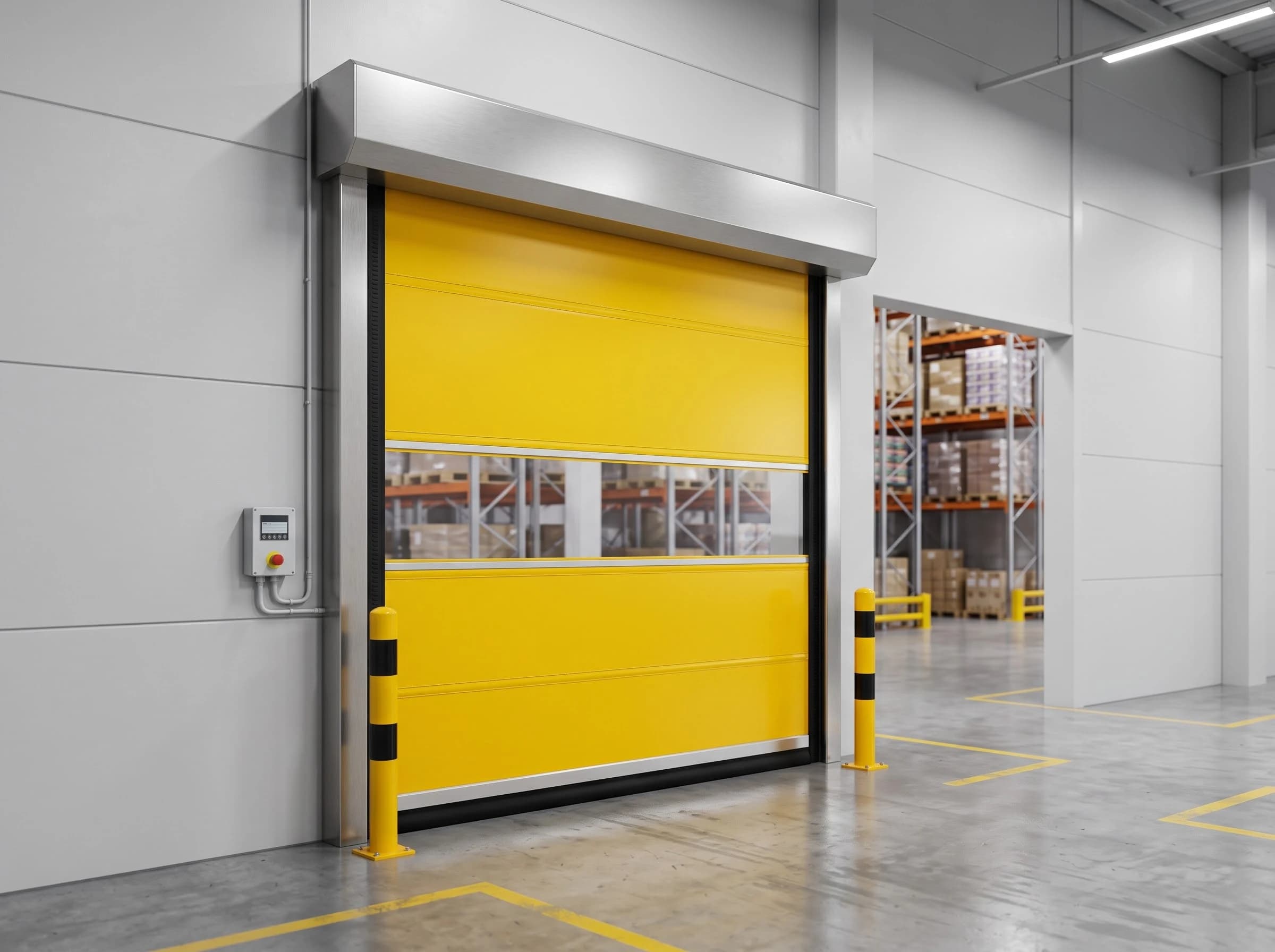
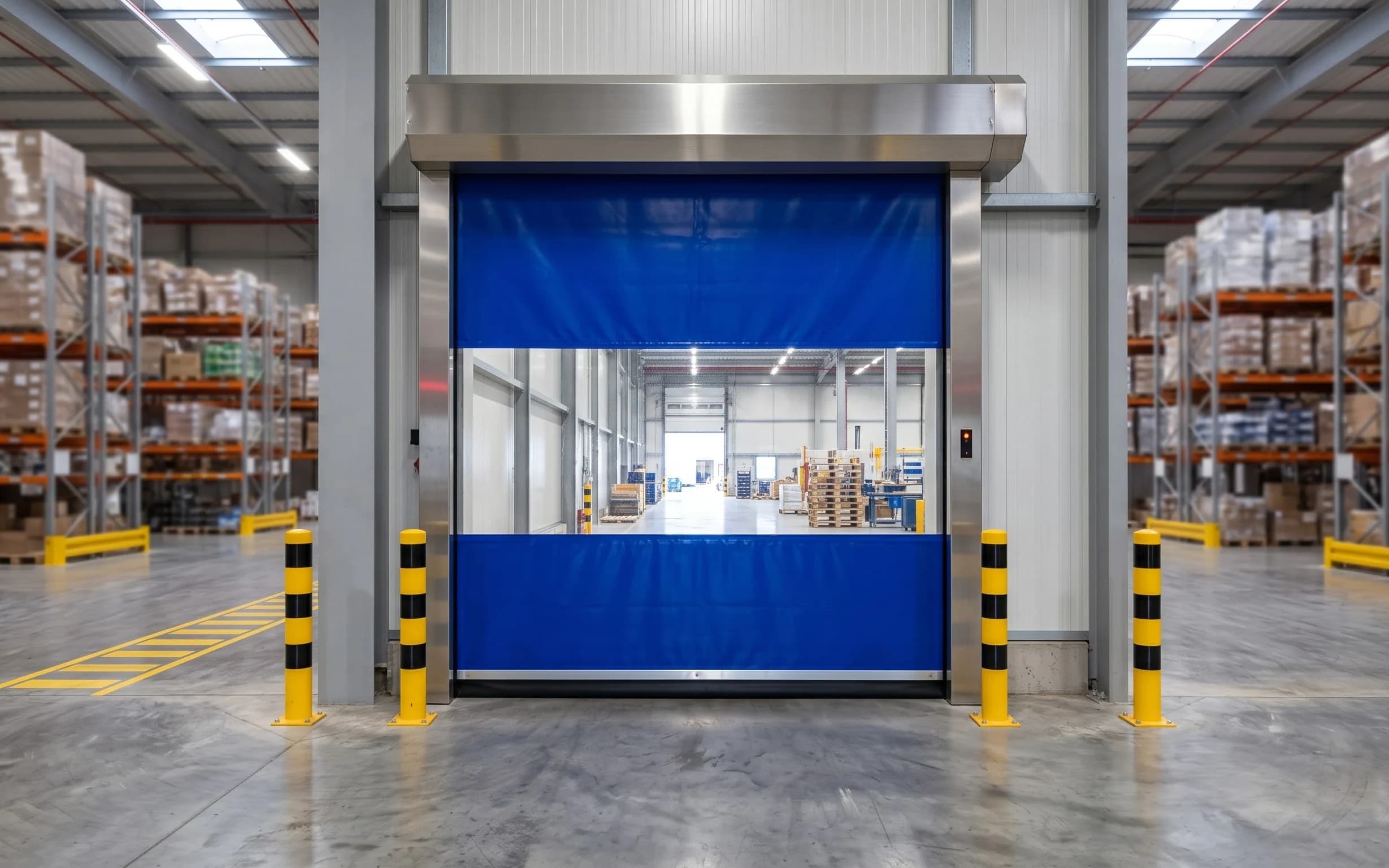
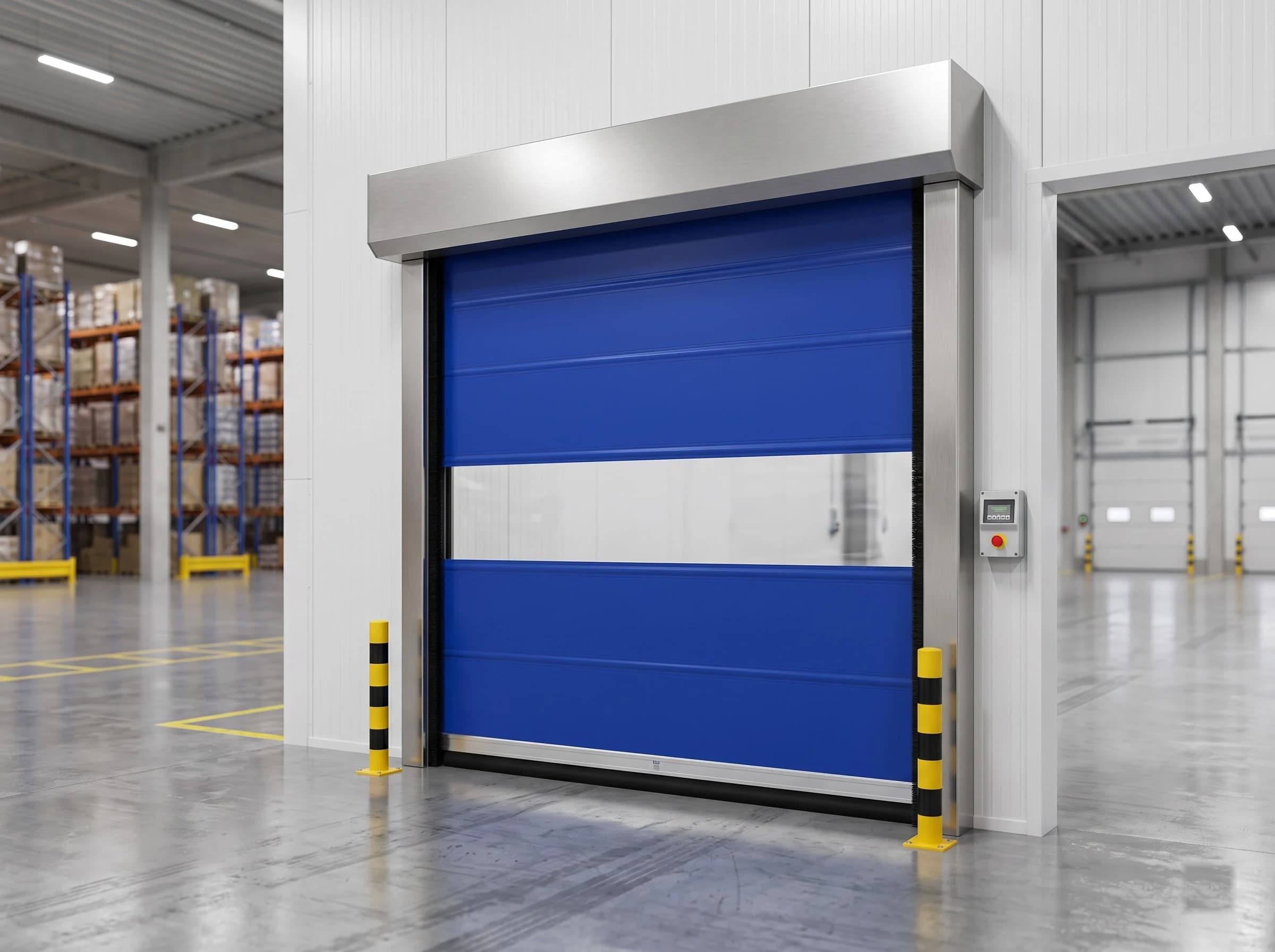
A safety-yellow high speed self-repairing door lowered to about two-thirds across a wide internal warehouse opening, its taut PVC curtain with a full-width clear vision band running in brushed stainless guide columns with flexible black retention channels beneath a plain stainless hood, the lit hall visible beneath the bottom rail, a wall control station with display and red emergency stop beside the guide and yellow-and-black bollards on the polished concrete floorHigh Speed Doors

Product visualisations. These images are built to a written specification of this door type rather than photographed on site, and they are replaced as installation photography becomes available. They illustrate construction and arrangement; the figures that matter are in the specification below.

Key specifications

Impact recovery
Automatic / self-resetting
Opening speed
Up to 2.0–2.5 m/s
Guides
Flexible self-repairing
Size
Engineered to the opening

* Final specification depends on door dimensions, configuration, operating environment and project requirements.

01Overview

About High Speed Self-Repairing Door

In an opening with continuous forklift traffic the door will be hit. On a conventional rapid door that means a torn curtain, a distorted guide and an aperture out of service until an engineer attends. The self-repairing configuration is designed around that certainty rather than against it: the curtain is retained in flexible guides by a system that releases under impact instead of tearing.

03Variants

Available configurations

The same product, built for a different job. Where a specification depends on opening dimensions, selected profile, operating duty or site conditions, the final configuration is confirmed during technical assessment.

  • Class 2 wind configuration

    The lower of the two published wind resistance configurations, for internal openings and sheltered elevations.

  • Class 3 wind configuration

    For openings that are both impact-exposed and wind-exposed, where a Class 2 assembly is not enough for the elevation.

10Gallery
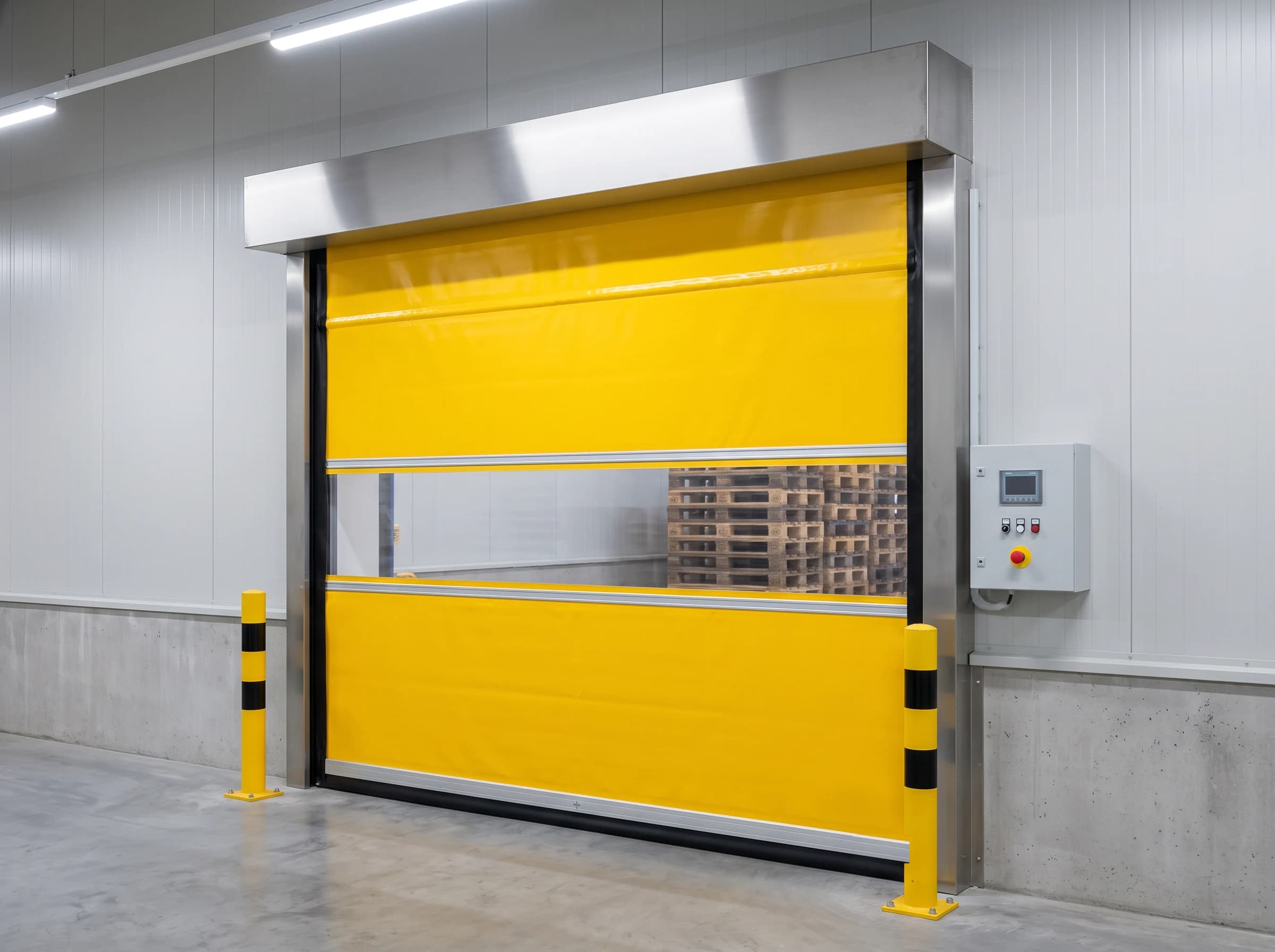
High Speed Self-Repairing Door in detail

  • A yellow PVC high speed self-repairing door seen from a three-quarter angle, closed, with its full-width clear vision band, brushed stainless hood and guide columns, wall control box and yellow-and-black bollards
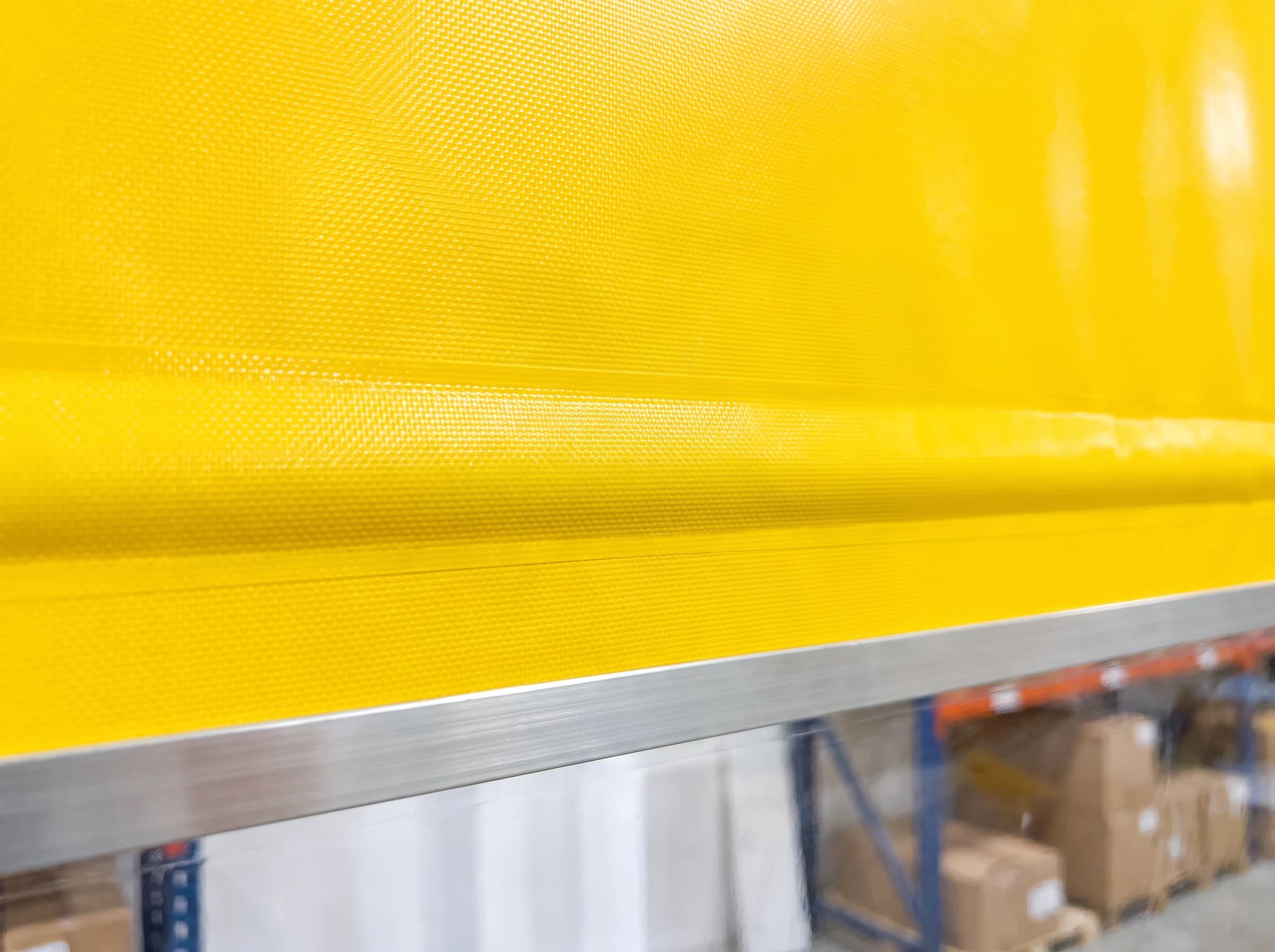
  • Close-up of the yellow reinforced PVC curtain of a high speed self-repairing door, showing the woven scrim texture under the coating, a welded horizontal reinforcing seam and the aluminium edge strip of the clear vision band
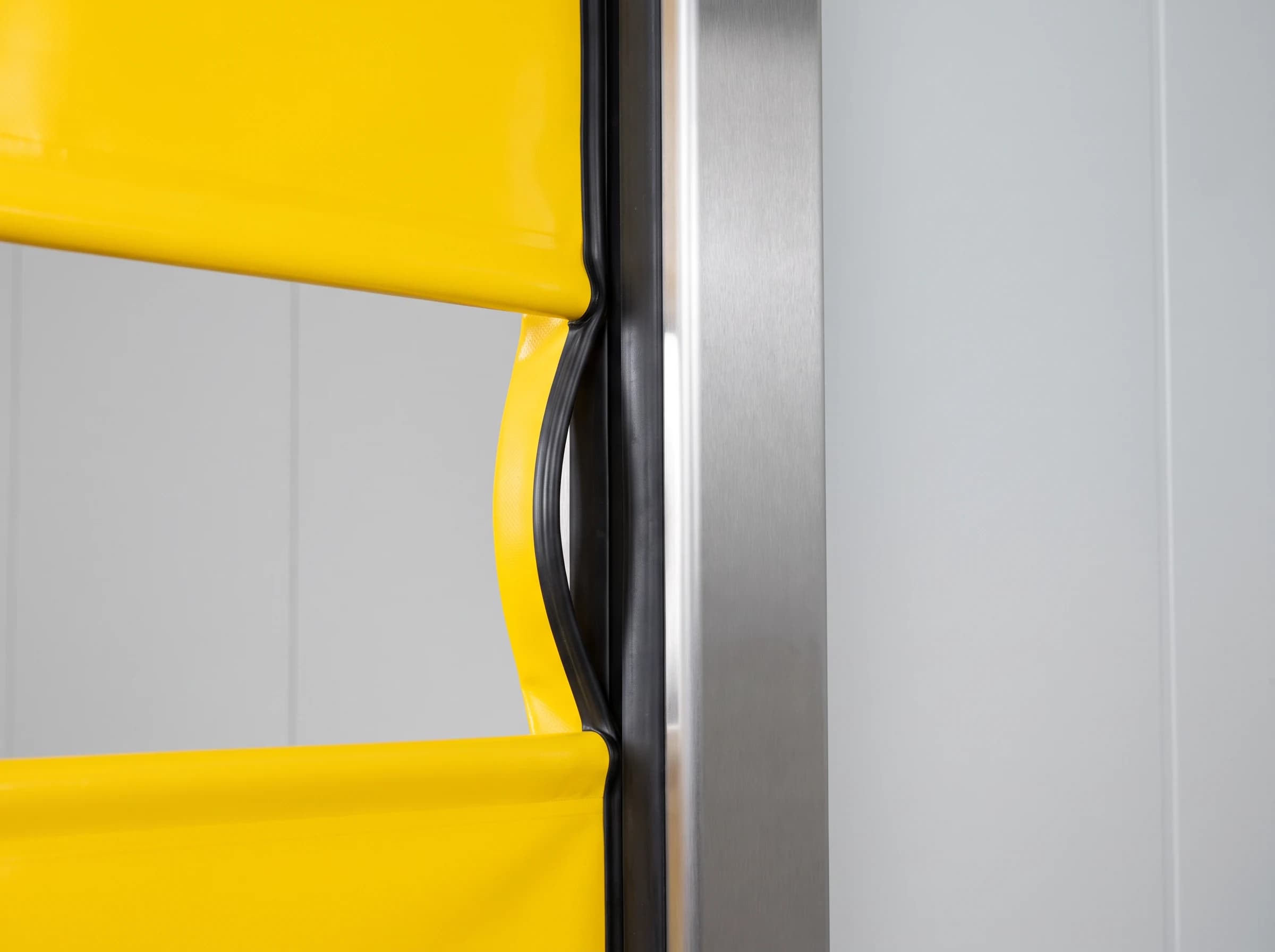
  • Close-up of the self-repairing guide of a high speed door: the yellow curtain's edge bead has released from the black flexible channel in the stainless guide over a short section after impact, the curtain bowing away undamaged while above and below the bead remains seated
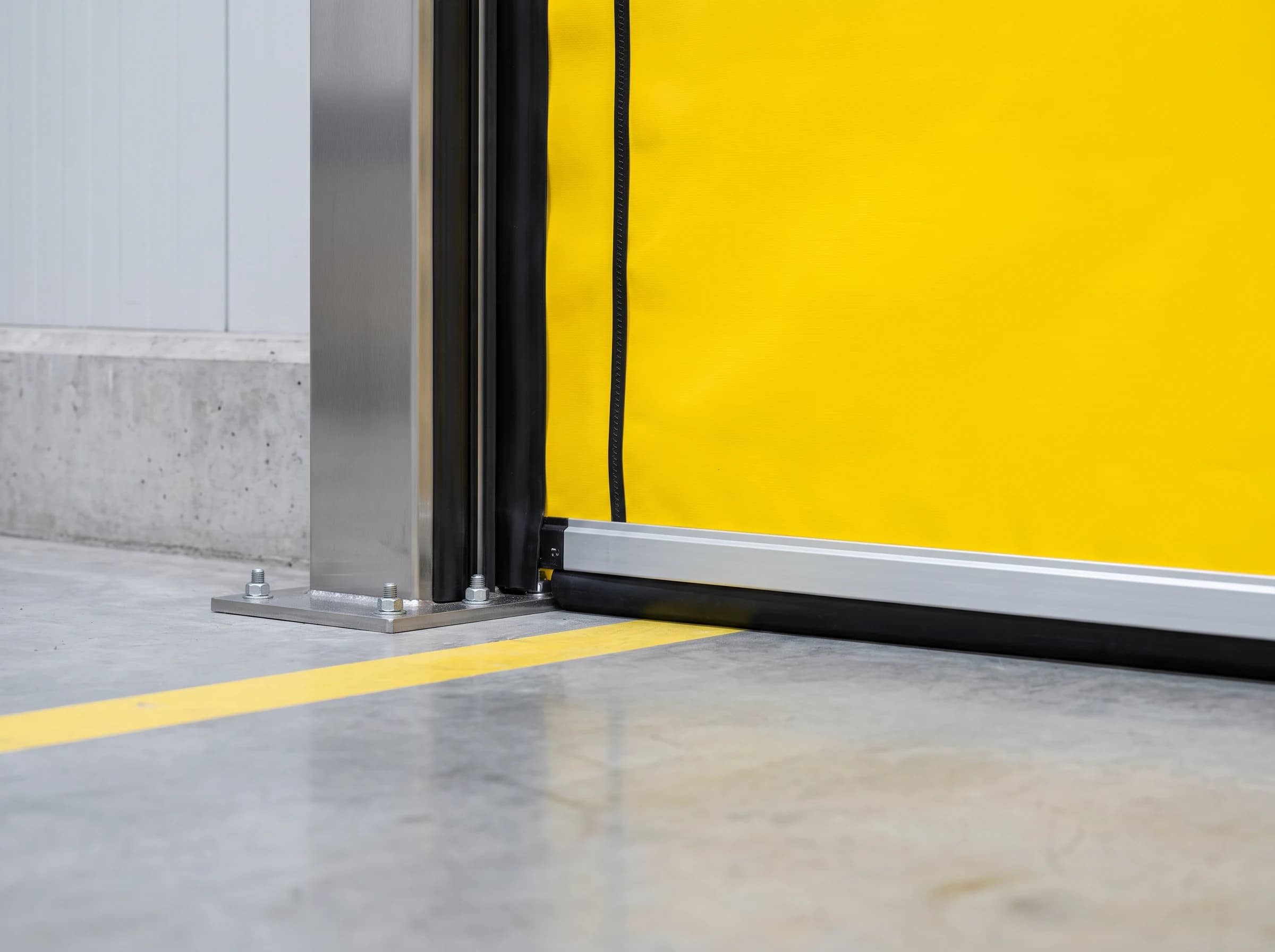
  • Bottom corner of a high speed self-repairing door: the aluminium bottom rail with its black soft floor seal, the foot of the stainless guide column bolted to the floor, and the curtain's edge bead running in the black flexible guide channel
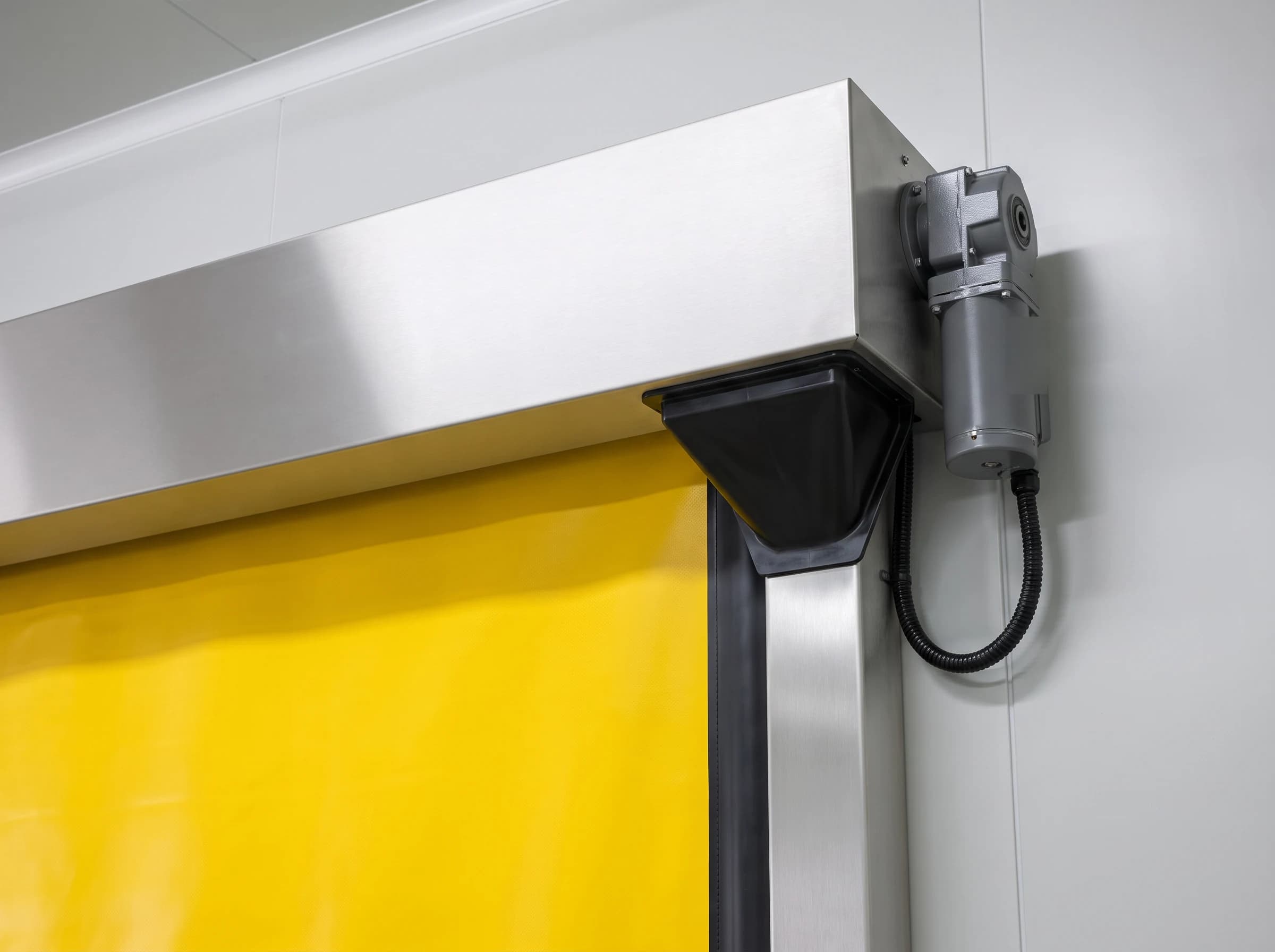
  • Top corner of a high speed self-repairing door: the plain stainless hood over the roller, the flared re-entry mouth at the head of the guide that re-threads the curtain edge, and the geared electric operator on the roller shaft end

04Technical specifications

Specification, features and ordering

Technical data is shown first; features, applications, compatibility, installation, safety, ordering and downloads are a click away.

Dimensions2 fields
Maximum width
Application dependent; engineered to opening
Maximum height
Application dependent
Performance3 fields
Opening speed
Up to 2.0–2.5 m/s
Closing speed
Approximately 0.5–0.8 m/s
Wind resistance
Typically Class 2–3 configuration

EN 12424 is the test method behind the wind load class.

Construction5 fields
Door type
Self-Repairing High Speed Door
Curtain
Flexible reinforced PVC
Guide system
Flexible self-repairing guides
Curtain recovery
Automatic re-entry into guide system
Impact recovery
Automatic / self-resetting
Drive & control3 fields
Drive
High-cycle geared motor
Control
Inverter-based controller
Activation
Radar / loop / pull switch / remote
Safety2 fields
Safety
Photocells + bottom safety edge
Emergency operation
Manual override
Options1 fields
Vision panel
Optional

Final specification depends on door dimensions, configuration, operating environment and project requirements.

FAQ

Questions we are actually asked

What does self-repairing actually mean?
The curtain is held in flexible guides by a system that releases under impact rather than tearing. After a strike the curtain re-enters the guide system automatically — the recovery is self-resetting, with no tools and no engineer visit.
Where is this door suitable?
Openings with heavy forklift and material handling traffic: warehouses, factories, logistics facilities and production areas, particularly on constrained routes where the guides sit close to the traffic line.
What opening sizes are possible?
Maximum width and height are application dependent and engineered to the opening rather than published as a fixed ceiling. Send us the aperture dimensions and we will confirm what is achievable for it.
How fast does it operate?
Up to 2.0–2.5 m/s opening and approximately 0.5–0.8 m/s closing, both subject to configuration. Impact tolerance does not cost you the cycle time.
Which activation systems are available?
Radar, loop detector, pull switch or remote. On a forklift route a loop or a pull switch is often preferred, because it opens the door for vehicles without responding to every pedestrian crossing the area.
What safety systems are included?
Photocells and a bottom safety edge, with manual override operation. The releasing curtain is itself a safety characteristic: a strike is absorbed rather than resisted.
Will it still hold a wind load?
It is published as a Class 2 to Class 3 configuration, subject to the specification for the opening. A door that has to release under impact and also hold a wind load is a genuine engineering trade-off, so we confirm it against the elevation rather than assuming it.
What information do you need to quote?
Clear width and height of the opening, the headroom and side room available, roughly how many cycles a day it will take, whether it is internal or external, and what the two sides of the opening have to keep different from each other. Five answers and a photograph are usually enough for a configuration and a price.

Engineering enquiry

Get a specification for High Speed Self-Repairing Door.

Five answers about the opening are usually enough for us to come back with a configuration and a price.

Loading enquiry form…

Get in touch

Or talk it through with an engineer.

If it is easier to describe the opening than to write it down, call or message us and we will work through it with you.
CallWhatsAppGet a quote